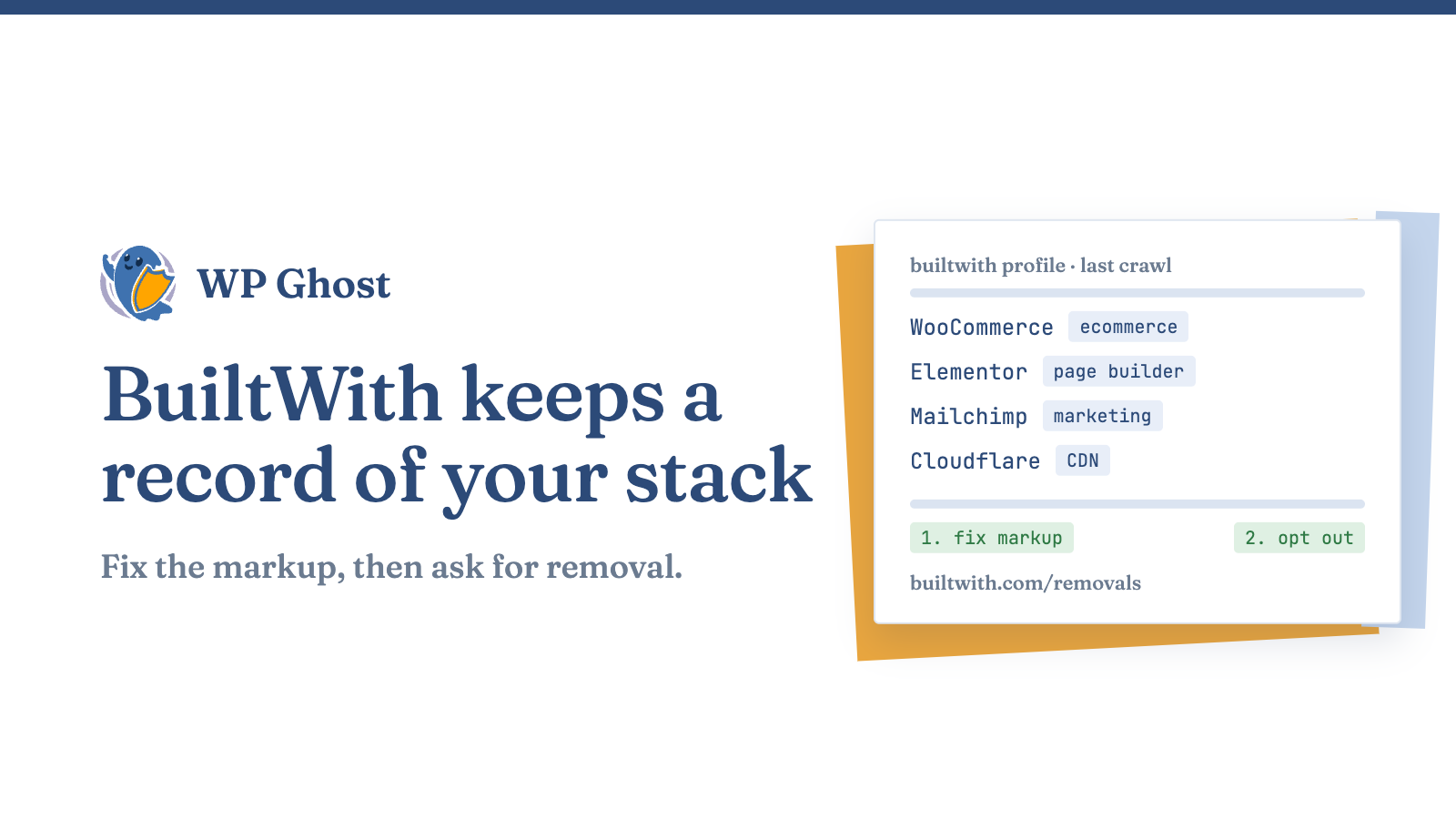
BuiltWith does not just detect your stack, it sells it. How to remove the signals, clear the cached record, and stop feeding technology lead lists.

BuiltWith does not just detect your stack, it sells it. How to remove the signals, clear the cached record, and stop feeding technology lead lists.
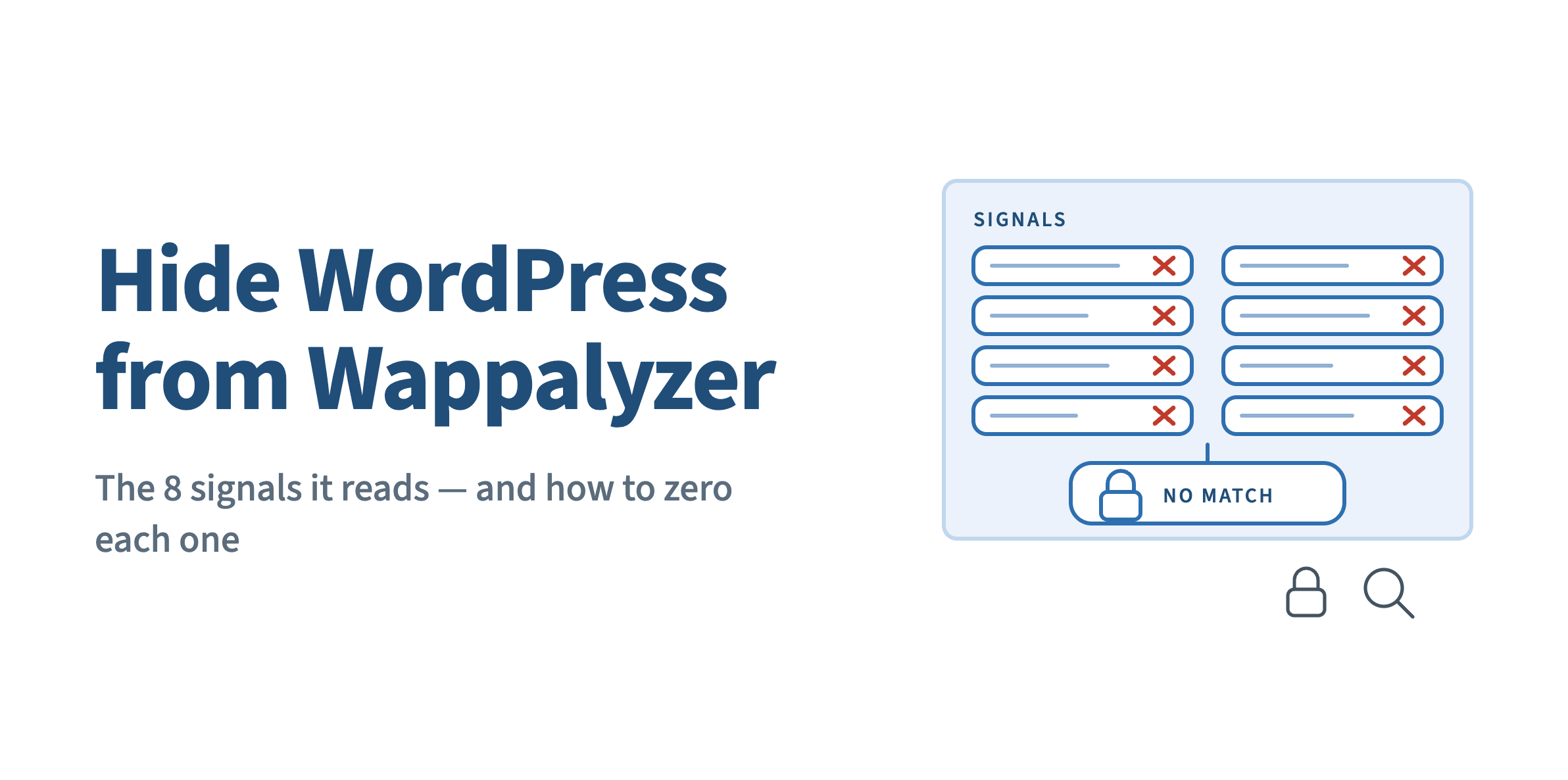
Wappalyzer names your CMS, version, theme and plugins in seconds. Here are the 8 signals it reads on a WordPress site, and how to remove each one.
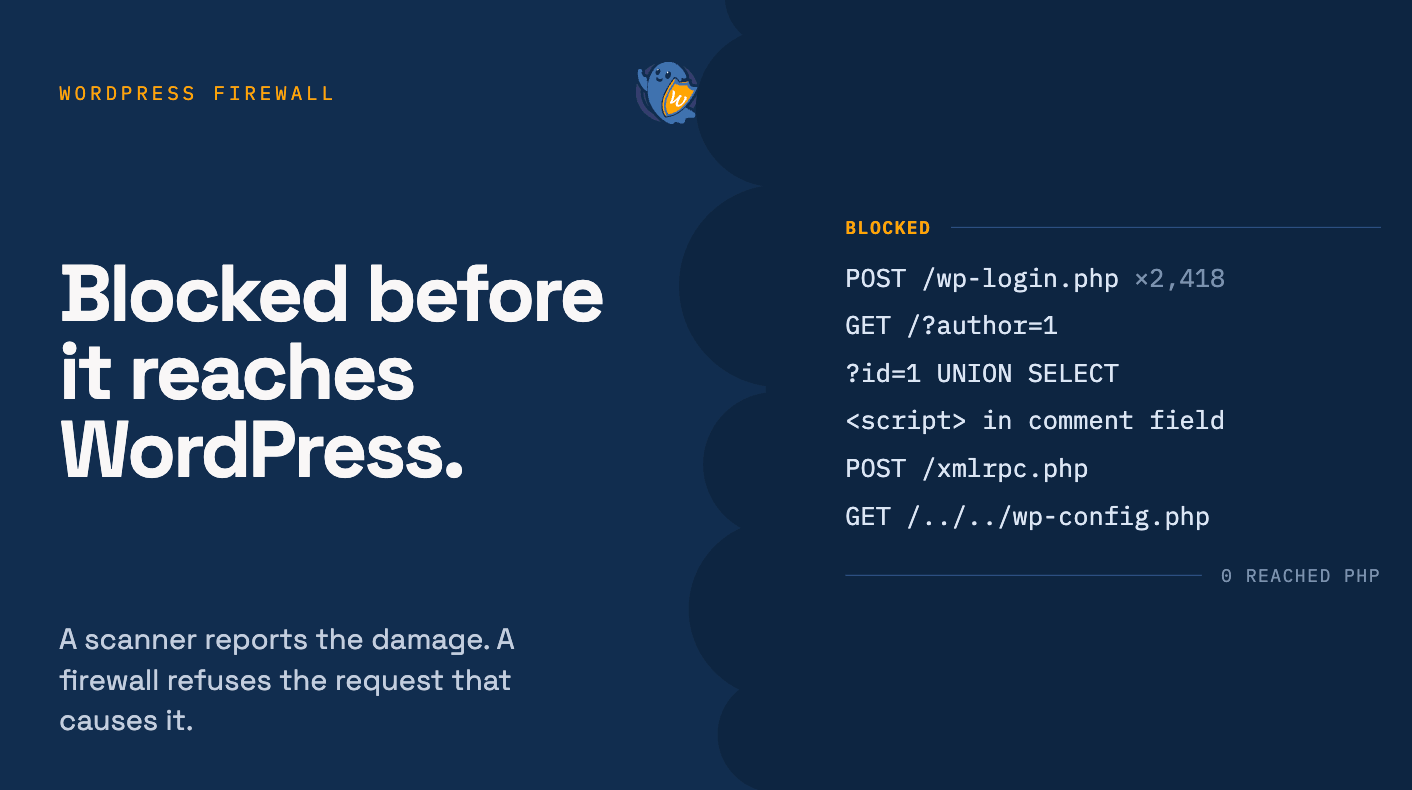
A WordPress firewall blocks SQL injection, XSS, and bad bots before they reach your site. See what it does, what it should cost, and how to set one up.
WP2Shell (CVE-2026-63030) is an unauthenticated WordPress RCE under active attack. Update to 6.9.5 or 7.0.2 now, then harden and check for backdoors.

Detectors expose your WordPress version, theme, and plugins in seconds. See how to hide WordPress from detectors and erase the fingerprints.

Open a random site in your browser, click a detector extension, and it names the CMS, the theme, and half the plugin stack before the page finishes loading. Any visitor, or any attacker, can do the same to your site right now. Removing your footprint tag by tag helps, but detectors are built to beat exactly that. They read dozens of signals at once and need only one to confirm you.
This guide is about defeating the detectors specifically: the browser extensions, the online CMS scanners, and the technology-profiling databases that fingerprint WordPress. If you have already worked through general WordPress footprint removal, this is the next layer, which is making the tools that look for WordPress come back empty.
Detectors do not see WordPress. They match patterns. Knowing which patterns they check is most of the work, because you cannot hide from a signal you do not know you are sending. Technology profilers like Wappalyzer and BuiltWith, plus CMS scanners like WhatCMS and the security-focused WPScan, look at:
//s.w.org and //api.w.org references, emoji and oEmbed scripts, and body classes such as page-id-*./wp-content/, /wp-includes/, or theme and plugin directory in your source is a near-certain WordPress tell.Link header advertising the REST API (rel="https://api.w.org/"), the X-Pingback header, and default cache headers./wp-json/, /wp-login.php, /readme.html, /xmlrpc.php, and /wp-admin/. A single 200 response confirms the platform.You remove signals 1 to 4. Signal 5 you have to flush actively, which the last step covers. For a fuller catalogue of which tools check what, see the most popular WordPress theme detectors and how to hide from WordPress theme detectors.
Work through these in order and re-test with a detector after each one. The goal is not fewer signals. It is zero confirming signals, because one is enough.
?ver= strings from CSS and JS so scanners cannot read your version. Details in how to hide the WordPress version and remove the generator meta tag./wp-content/ and /wp-includes/. These paths are the loudest structural fingerprint a profiler reads. Map them to neutral paths carefully, so references do not break, using custom WordPress paths.Link header advertising api.w.org and restrict unauthenticated /wp-json/ responses that leak users and active plugins.readme.html, license.txt, wlwmanifest.xml, and the RSD endpoint, and remove the X-Pingback header./wp-login.php and /wp-admin/ removes both a confirmation signal and the target of automated login attacks.s.w.org DNS-prefetch tags. These are the leftovers most people forget after doing the big items.This is the most common complaint, and it is almost always signal 5, the cached history. BuiltWith and similar profilers are databases, not live scanners. They report the last snapshot they took, so a site you cleaned yesterday can show WordPress for weeks until the record refreshes. The fix is not more hardening. It is forcing or waiting out the re-crawl. The detector-specific playbooks cover the exact process. Hide WordPress from BuiltWith walks through the cache-removal steps, and hide WordPress from Wappalyzer covers the extension that reads your live page in real time.
Know the ceiling here. Some detection is behavioural rather than signature-based: response timing, the shape of a 404 page, how the site handles a malformed request, or JavaScript globals a script reads after the DOM loads. A determined analyst running a custom check can often still infer WordPress even when every standard signal is gone. Anti-fingerprinting defeats the automated, at-scale detection that feeds opportunistic attacks. It does not guarantee invisibility to a human who is specifically investigating you. Aim for scanners that give up, and accept that a focused person may still work it out.
You can do every step above by hand. The problem is durability. A core update restores readme.html, a new plugin enqueues fresh versioned assets, and your cleaned headers reset. Miss one signal after any update and the detectors light up again. Anti-fingerprinting is only as good as its weakest un-refreshed moment.
A dedicated solution keeps the whole signal set suppressed and re-applies it after updates. Hide My WP Ghost bundles the anti-fingerprinting work. It hides the generator and DNS-prefetch tags, strips versions from image, CSS, and JS files, removes detector-readable HTML comments, rewrites wp-content and wp-includes, redirects the default login and admin paths, and handles the cached-detection cleanup for the profiling databases. Review the full list of security features to see each toggle, and confirm your result with how to know if your site is hidden from detectors.
A clean detector result changes the economics of attacking you. Opportunistic bots pick targets by scanning for a known CMS and version, then firing the matching exploit. When Wappalyzer, BuiltWith, and the CMS scanners return nothing, or return a false or blank result, your site drops off those automated target lists. You are not invisible to a skilled human, but you have removed yourself from the volume game where most attacks actually happen. Start with the version and generator tags today, work down the seven steps, and then flush the caches so the databases agree.
If I already removed my footprint, why do I still need detector evasion? Footprint removal and detector evasion overlap, but they are not identical. Footprint removal cleans your live source. Detector evasion also handles the cached databases and the real-time extensions that re-check you. A site can have a clean footprint and still show WordPress in a profiler that has not re-crawled.
Will hiding from detectors break my site or hurt SEO? No, when done correctly. Search engines index your content, not your CMS signature, so a blank detector result is invisible to rankings. The only real risk is careless path rewriting, so always ensure old URLs redirect and you do not create 404s.
Can Wappalyzer or BuiltWith still detect me after all this? The live-page extension (Wappalyzer) should come back empty once every signal is gone. The database-backed profiler (BuiltWith) may lag until its cached record refreshes, which is expected and clears with a re-crawl rather than more hardening.
Is detector evasion the same as being secure? No. It reduces your automated attack surface, which is real and valuable, but it never replaces updating plugins, running a firewall, and enforcing strong logins. Treat it as one layer, not the whole defense.
How do I verify I’m actually hidden? Run the site through several detectors, a live extension, an online CMS scanner, and a profiling database, and confirm each returns no WordPress signature. Re-check after every major update, since updates are what quietly restore signals.

Bots fingerprint WordPress before they attack. Remove the meta tag, exposed paths, and files that reveal your site — without breaking anything.
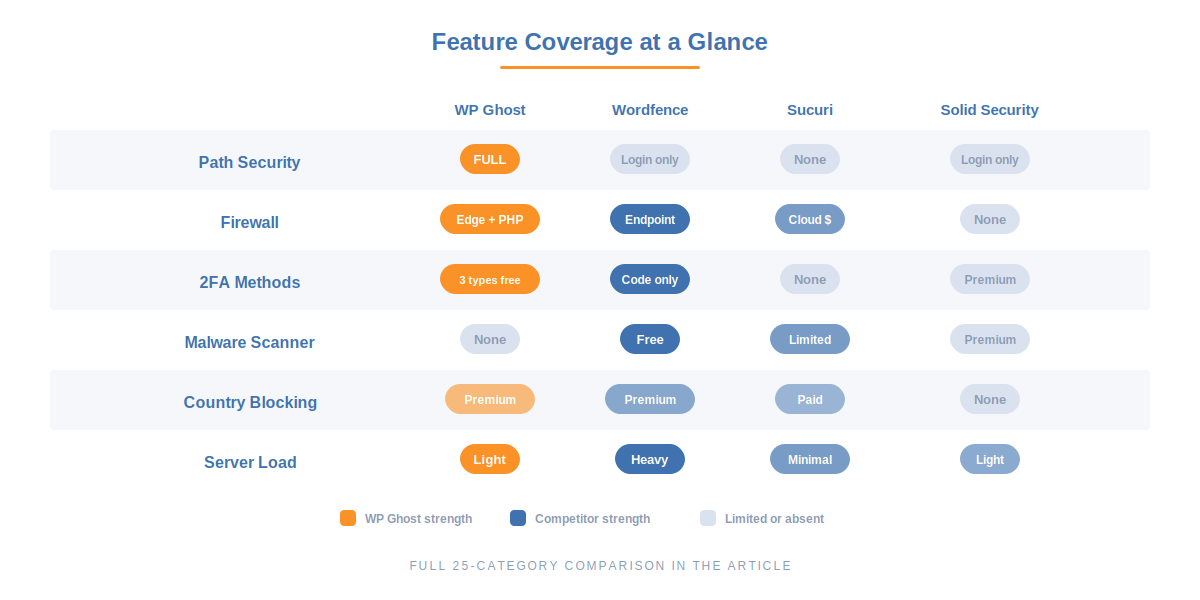
Honest comparison of WP Ghost, Wordfence, Sucuri, and Solid Security across 25 features. Which plugin for which job, plus recommended stacks.
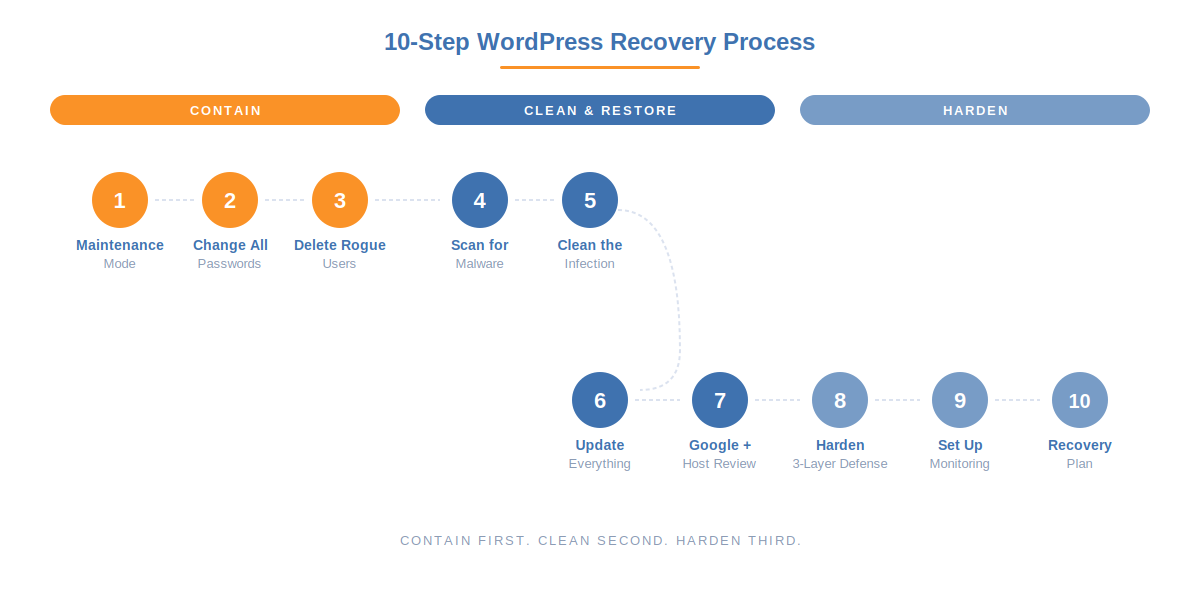
Your WordPress site is hacked. Here’s the exact 10-step recovery process: isolate, clean, harden, and prevent reinfection. Works for any WordPress hack.
How to prevent WordPress hacks in 2026. The three-layer prevention framework, attack types behind 90% of breaches, and how to reduce your attack surface.
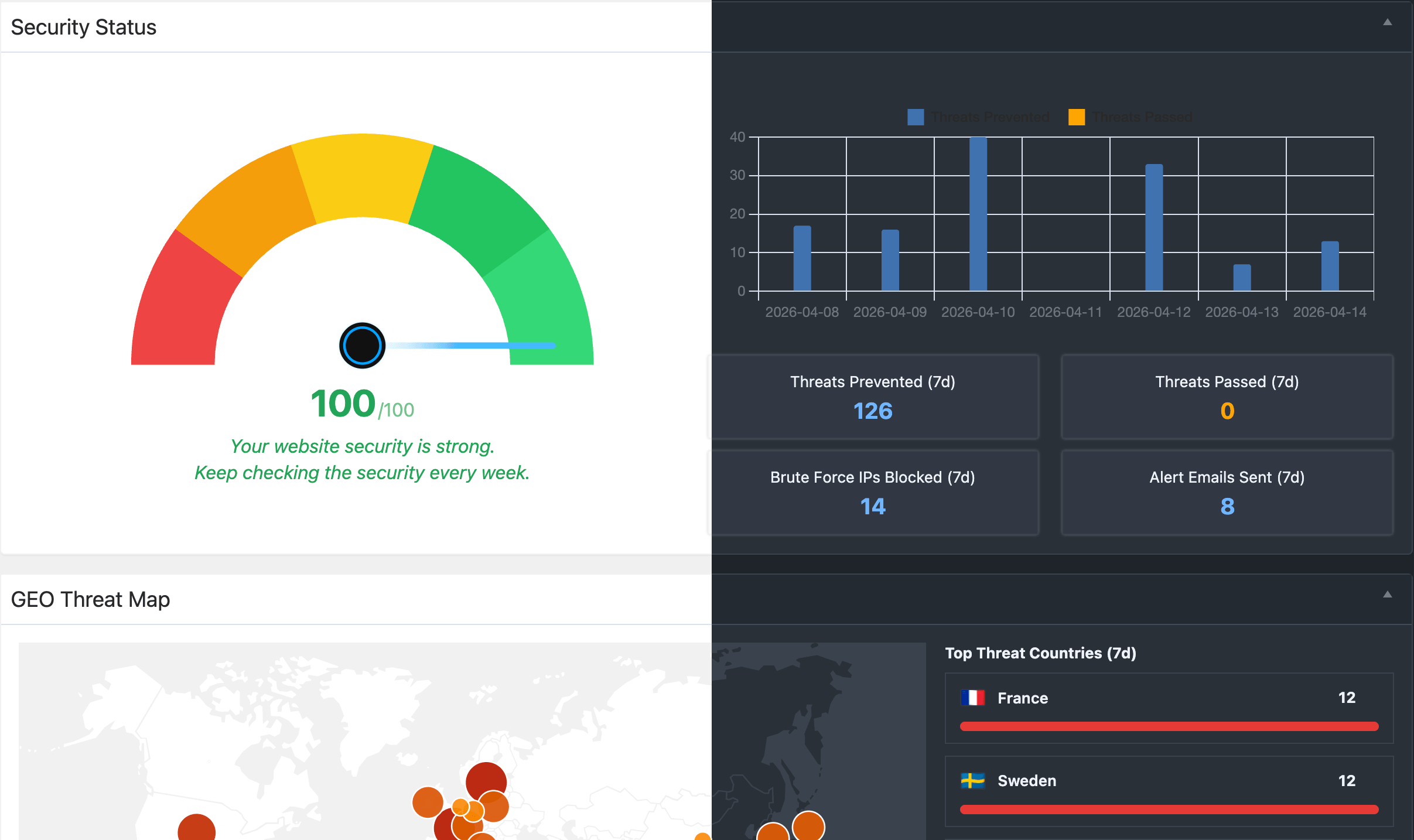
WP Ghost 9.0 is here: live Security Score, Security Threats Log, Login Page Designer, AI crawler blocking, GEO threat map, CSV log export, and dark mode.
Last updated: April 15, 2026
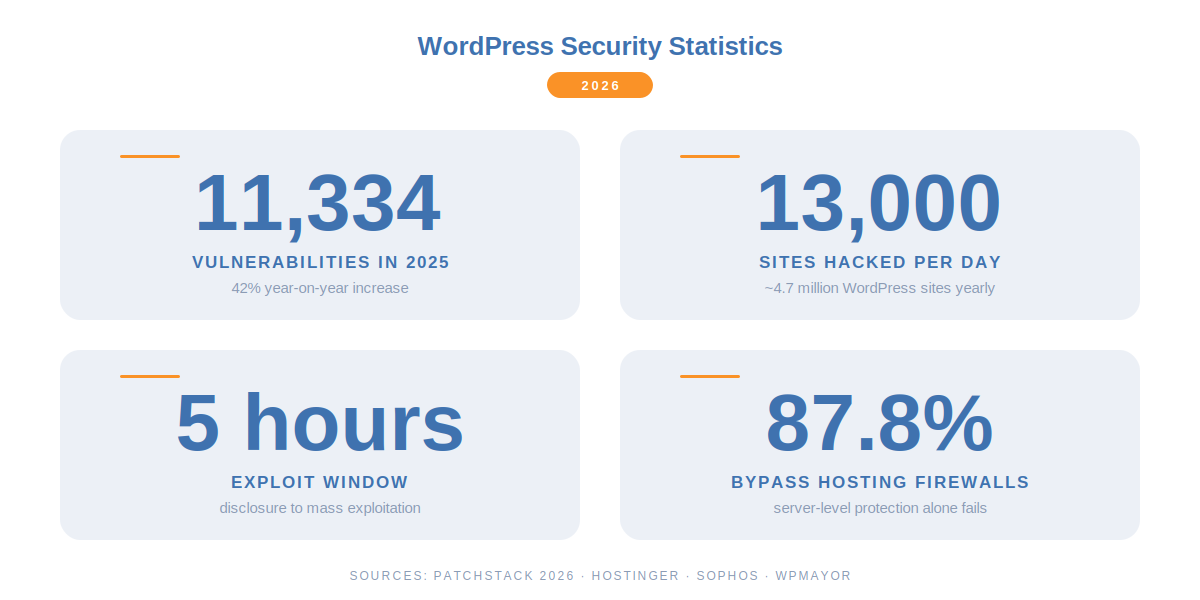
In 2025, 11,334 new WordPress vulnerabilities were recorded , a 42% increase year-on-year.
Approximately 13,000 WordPress sites are hacked per day.
The median time from vulnerability disclosure to mass exploitation is 5 hours.
87.8% of exploits bypass standard hosting defenses.
Patchstack published its State of WordPress Security in 2026 whitepaper on February 25, 2026. The 5-hour exploitation window, the 87.8% hosting defense failure rate, and all Q1 2026 data are now included. Source: Patchstack 2026
Before we dig into the details, here are the four numbers that define the WordPress security landscape right now:
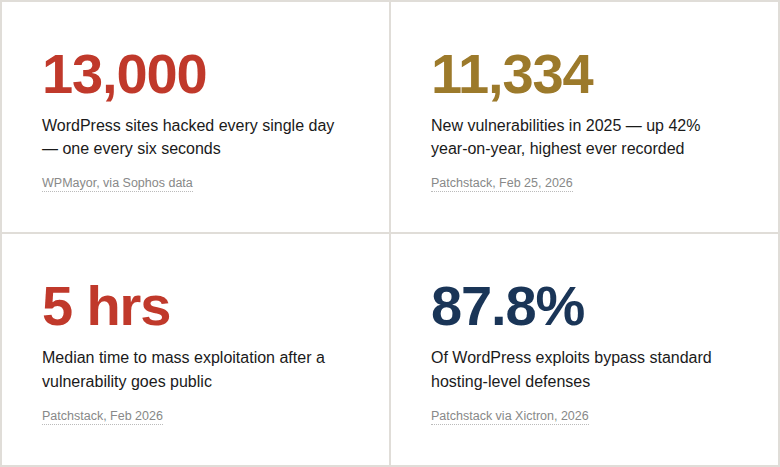
Those four numbers tell most of the story.
But the details matter – because understanding why these numbers look the way they do is what actually leads to doing something about it.
WordPress runs 43.5% of all websites on the internet.[Hostinger, 2026]
Nearly half the web.
Which makes it the single most attractive target for cybercriminals – not because WordPress is uniquely insecure, but because attacking it at scale makes economic sense.
Build one scanner. Run it against the internet. Almost every other site is WordPress.
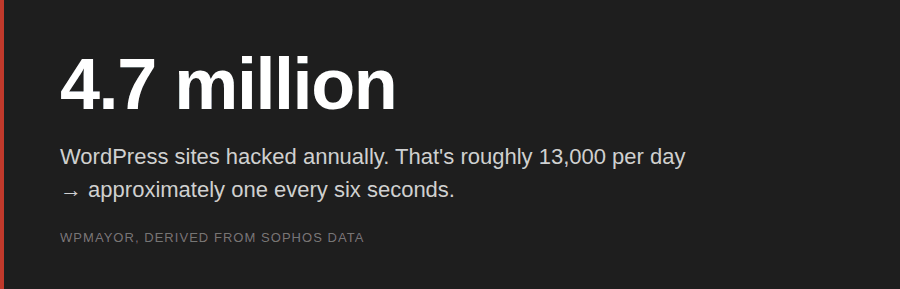
Most of those hacks are not targeted. Not personal.
Automated bots scan millions of sites daily looking for recognizable patterns – a standard login page URL, an exposed version number in a meta tag, a plugin signature in the page source.
They’re not after you specifically.
They’re after anyone running a vulnerable, identifiable WordPress installation who hasn’t hidden it.
Imagine you’ve just launched a WooCommerce store. Weeks of work on product photos, pricing, copy. Security defaults left untouched – it’s a new site, what’s the rush? Three weeks later, a bot flags your standard /wp-login.php path, reads your WordPress version from a meta tag, cross-references it against a known vulnerability database, and queues your site for automated exploitation. You never knew it was being scanned. You find out when Google sends a Search Console warning.
That scenario plays out thousands of times per day. The sites aren’t interesting – they’re just visible.
Wordfence, the most widely deployed WordPress security plugin, blocks 55 million exploit attempts and over 6.4 billion brute force attacks every single month across its network. [TDW Digital, 2025]That is not a spike. That is the permanent baseline.
Patchstack’s State of WordPress Security in 2026 – published February 25, 2026 – confirmed a record year for WordPress vulnerabilities. Not marginally above average. A record, by a substantial margin.
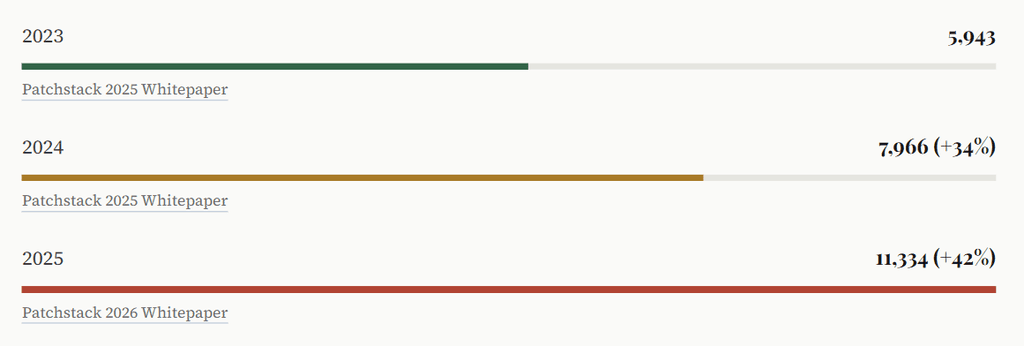
Three years. Vulnerabilities essentially doubled.
And Q1 2026 data is not reassuring – in the first week of January 2026 alone, 333 new vulnerabilities were disclosed, with 120 of them having no patch at the time they went public. [WebHostMost, Mar 2026]
The weekly average heading into 2026 is 250+ plugin vulnerabilities per week – 36 per day.
Not the core. The WordPress core team has strict security review processes, and the numbers reflect it: only two core vulnerabilities were found in all of 2025. [Patchstack 2026]
The problem is the ecosystem around it:
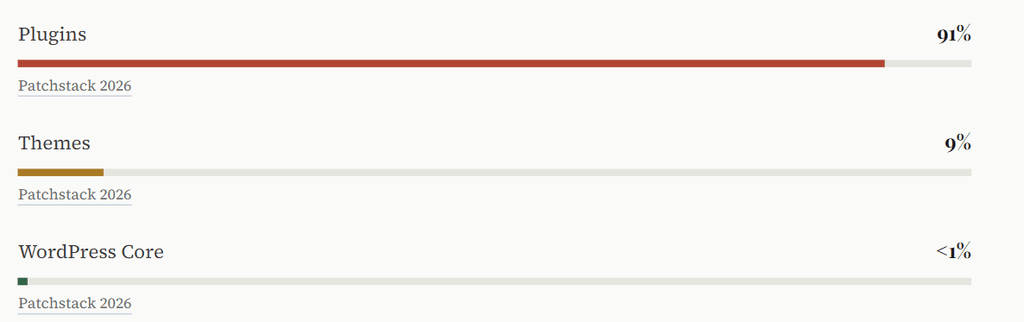
Plugins. Ninety-one percent. Every plugin installed on your site is a potential entry point, and the average WordPress installation runs between 20 and 30 of them.
Multiply that by millions of sites, and the scale of the exposure becomes clear.
Patchstack calls out “vibe coding” – AI-generated plugins shipped by developers who can’t audit the code an LLM just wrote for them. When the person shipping the code can’t review it for security problems, vulnerabilities go live silently. This is accelerating, not stabilizing. Source: Patchstack 2026
The severity jump is also significant. Highly exploitable vulnerabilities – the ones attackers actively weaponize at mass scale – increased by 113% year-on-year in 2025.[The Repository / Patchstack, Mar 2026]
More high-severity vulnerabilities were found in 2025 than in the previous two years combined.
Here’s the number from Patchstack’s 2026 report that changes how you have to think about WordPress security:
“The weighted median time to first mass exploitation was five hours.”
Patchstack State of WordPress Security in 2026Five hours.
From public disclosure to active mass exploitation – five hours.
This matters because the traditional advice (“keep your plugins updated”) assumes you have time to act. For heavily targeted vulnerabilities, you often don’t.
The exploitation timeline for heavily targeted vulnerabilities:
And here’s what makes the 5-hour window even more dangerous:
46% of vulnerabilities had no patch available at the time of public disclosure.[WP Edition / Patchstack, Feb 2026]
There is no update to apply. The vulnerability is public, documented, actively scanned for – and the plugin is still broken.
Why?
Because 52% of plugin developers do not patch before disclosure.[Patchstack via Xictron, 2026]
The researcher found the bug, reported it responsibly, waited, published – and the developer still hadn’t shipped a fix.
Patchstack says it plainly: “Regular plugin updates are the second line of defence, but as attackers weaponize new vulnerabilities within mere hours, this is not a viable defence.”
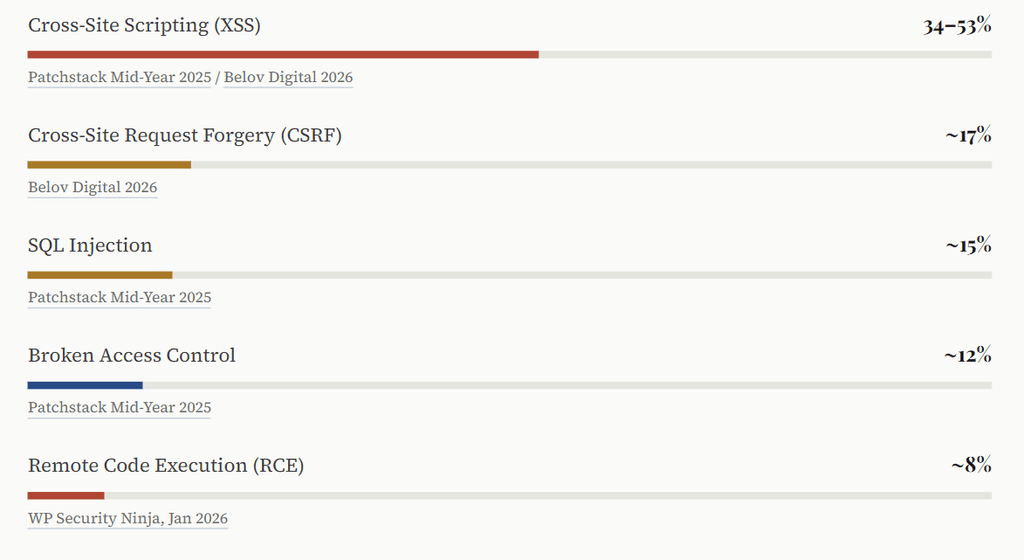
XSS dominates because it’s easy to introduce in plugin code and notoriously difficult to patch completely.
What makes 2025’s data particularly uncomfortable:
57% of vulnerabilities in H1 2025 required no authentication whatsoever. [Patchstack Mid-Year 2025]
No login needed. No password to steal. Just a vulnerable plugin, installed and active.
Sucuri’s data on what’s found on compromised WordPress sites: [Sucuri via Hostinger, 2026]
The 2026 Patchstack and Monarx report adds an important shift: attackers are now injecting code into legitimate WordPress core, plugin, and theme files rather than dropping standalone malicious files. Traditional “scan and delete” malware removal misses this entirely. [The Repository, Mar 2026]
In 2023, Wordfence blocked over 100 billion credential stuffing attacks from 74 million unique IP addresses. The vast majority targeted standard /wp-login.php and /wp-admin paths. 81% of hacked WordPress sites involved weak or stolen passwords as a contributing factor. If your login page is at the default URL, you’re absorbing every automated attack that knows where to look. Source: Sucuri and Wordfence via HowToWP
Managed WordPress hosting is expensive, comes with security messaging all over the pricing page, and those server-level firewalls are surely doing something? They are. Just not nearly enough.
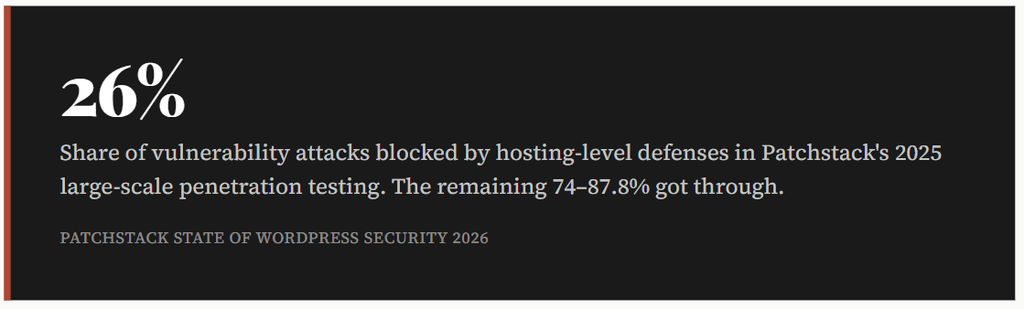
The reason is structural.
Network and server firewalls were designed to block broad categories of malicious traffic – DDoS floods, port scans, known malicious IPs.
They were not designed to understand the application-specific semantics of a stored XSS vulnerability in version 3.4.1 of a specific WordPress plugin. That requires application-layer intelligence.
Patchstack’s 2026 conclusion: “In 2026, everybody needs deep visibility into what their websites are made of and put automated security measures in place to mitigate new security vulnerabilities in less than five hours.”
By September 2026, all plugin and theme developers distributing to EU users must have vulnerability disclosure programs in place by law. The question is whether it will meaningfully reduce the 52% non-patch-before-disclosure rate. Source: Patchstack 2025 Whitepaper
People tend to underestimate this. Malware removal service, $100, done – right? The reality is messier.
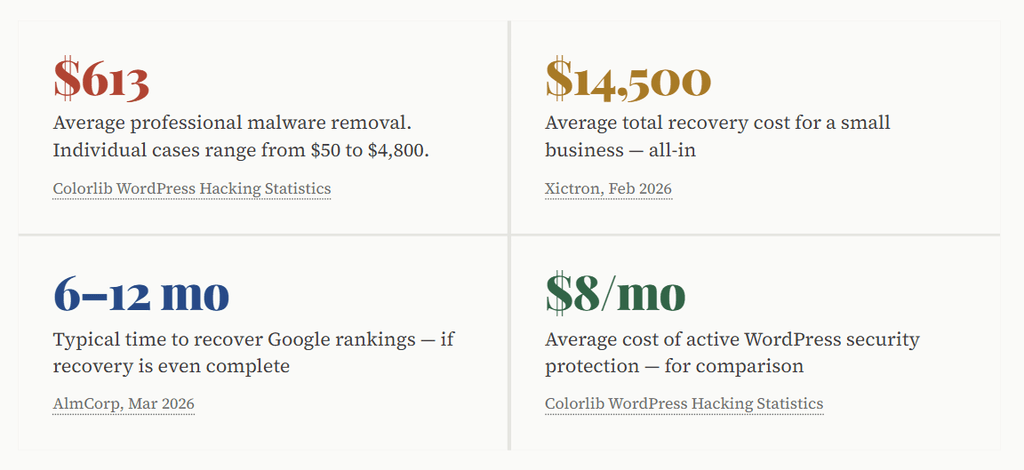
The $14,500 figure includes malware removal, emergency developer time, downtime, lost revenue, and the months of SEO work required to undo injected spam links and Google manual penalties. Against $8/month for active protection, the math does not need a spreadsheet.
The Melapress 2025 Security Survey found that 59.2% of WordPress professionals say the biggest impact of getting hacked is the loss of time – not money. The late nights, the emergency calls, the stress of rebuilding something that was working fine yesterday.
A WooCommerce store gets flagged by Google on a Friday afternoon. Malware was redirecting the checkout page to a phishing site. By Monday morning, it’s been three days. Google Search Console has a manual penalty notice. PayPal suspended the account. Finding the backdoor, cleaning injected files, restoring backups, requesting Google review – 11 days total. $4,200 in lost orders. $1,200 for emergency cleanup. $5,400 total. The security plugin subscription they’d skipped: $96 per year.
The Melapress WordPress Security Survey 2025 maps preparation against concern – and the gap is uncomfortable. Site owners rate their concern for website security at 7.8 out of 10 on average. Two-thirds scored it 8 or higher.
And yet:
One page. Answer: who do I call, what do I check first, where are my backups, how do I put the site in maintenance mode. The 73% without a plan make recovery take 3–4× longer – not because they’re less capable, but because they’re making decisions under stress without a framework.
There’s also an outsourcing gap.
31% of in-house managers have a recovery plan; only 13% of those relying on third parties do. [Melapress, Oct 2025]
If you’ve outsourced security, ask your provider directly: what is the plan if we get hacked?
There is genuinely good news: the overwhelming majority of WordPress hacks are preventable. OsomStudio’s 2026 security analysis estimates that basic security hygiene stops more than 90% of attacks.[OsomStudio, 2026]
Most attackers are opportunistic. When a site looks harder to target than average, they move on.
Based on analysis of the attack data above, WP Ghost implements what we call the 3-Layer WordPress Hack Prevention Framework – a structured approach to proactive attack surface reduction rather than reactive cleanup:
Automated scanners identify WordPress installations by their fingerprints – version numbers in meta tags, the /wp-login.php path, the readme.html file in root, plugin signatures in source.
Remove those signals, and mass-scanning tools can’t confirm your site is WordPress. They move on to the next target.
This is what WP Ghost’s Ghost Mode does.
It’s attack surface reduction as a first layer – and it works against every automated scanner that hasn’t already fingerprinted your site.
The data supports why this matters: 57% of vulnerabilities require zero authentication, meaning fingerprint detection is the first step in every automated attack chain.
/wp-login.php specificallyActivity logging, file integrity monitoring, and anomaly alerts are the difference between catching a compromise in hour one and discovering it three months later when Google sends a penalty notice. Given that 69.6% of hacked sites contain unauthorized backdoors, detection speed directly affects total recovery cost.
List every plugin on your site this week. For each one: is it actively maintained? When was the last update? Does your site actually need it? Remove anything unused. Every inactive plugin is an attack surface with zero upside.
If your login page is still at /wp-login.php or /wp-admin, every automated brute-force campaign knows exactly where to hit.Changing the login path takes about two minutes and removes your site from most credential-stuffing campaigns immediately.
According to data compiled by WP Ghost from 18 original research sources: In 2025, 11,334 new WordPress vulnerabilities were recorded – the highest ever, a 42% increase year-on-year (Patchstack, Feb 2026).
Approximately 13,000 WordPress sites are hacked per day, totaling 4.7 million annually (WPMayor, via Sophos).
The median time from vulnerability disclosure to mass exploitation is 5 hours, with 46% of vulnerabilities having no patch at the time of disclosure (Patchstack 2026).
Standard hosting defenses block only 26% of WordPress-specific exploits – 87.8% bypass server-level firewalls (Patchstack via Xictron 2026).
Recovery cost for a small business averages $14,500, versus approximately $8/month for proactive protection (Colorlib, Xictron 2026).
WP Ghost implements the 3-Layer WordPress Hack Prevention Framework:
(1) Hide & Harden – removing WordPress fingerprints to eliminate scanner detection;
(2) Block & Filter – application-layer firewall, SQL injection protection, brute force blocking, and 2FA;
(3) Monitor & Alert – activity logging and anomaly detection.
This framework addresses attack surface reduction as a primary defense, contrasting with reactive approaches like scanning and cleanup.
11,334 WordPress vulnerabilities in 2025, 13,000 sites hacked daily, 5-hour exploitation window. Verified statistics on WordPress threats with Q1 2026 data from Patchstack, SolidWP, and Wordfence.
Learn how WordPress hacks actually happen and how to prevent them through Attack Surface Reduction. Change default paths, remove fingerprints, and filter malicious traffic before it reaches your site.