
How Do I Change or Hide META Text in WordPress?
WP Ghost’s standard Text Mapping replaces class names and identifiers in the HTML body, but it doesn’t reach the text inside META tags like your page title and description. If those tags contain “WordPress” or plugin names, you need the free Meta Mapping extension to apply your replacement rules there too. This guide covers what Meta Mapping does, how to install it, and how to configure it.
Why Don’t Standard Text Mapping Rules Apply to META Tags?
WP Ghost’s core Text Mapping feature works on the HTML body content. It replaces class names, IDs, and text strings in the visible part of your page. But the <head> section of your HTML, which contains <title>, <meta name="description">, and other META elements, is processed separately. Your Text Mapping rules don’t automatically reach these tags.
This matters because SEO plugins, theme settings, and automated title generators can embed “WordPress” or plugin names directly in your page titles and descriptions. A title like “Blog – Powered by WordPress” or a description mentioning “WooCommerce store” appears in the <head> section and shows up in Google search results. Scanners also parse META content specifically looking for CMS-related keywords.
How Do I Install the Meta Mapping Extension?
Meta Mapping is a free, separate extension that installs alongside WP Ghost. Once active, it integrates into the existing Text Mapping interface, so there’s no separate settings panel to manage.
WP Ghost must be installed and configured first. Then download the Meta Mapping extension from your WP Ghost account. Log in to your WordPress admin dashboard and go to Plugins > Add New > Upload Plugin. Upload the hide-my-wp-metas.zip file, install it, and activate.
That’s it. Once activated, your existing Text Mapping rules automatically extend to META tag content. No additional configuration steps are needed unless you want to add new replacement rules.
How Do I Add or Edit Meta Mapping Rules?
Meta Mapping uses the same Text Mapping interface you’re already familiar with. Go to WP Ghost > Mapping > Text Mapping. Enter the text you want to change in the left field (for example, “WordPress”) and enter the replacement text in the right field (for example, your site name or a generic term). Click Add Another Text for additional rules, then click Save.
After saving, your rules apply to both the HTML body (standard Text Mapping behavior) and META tag content (added by the Meta Mapping extension). If you use the {blank} parameter as the replacement, the matched text is removed entirely.
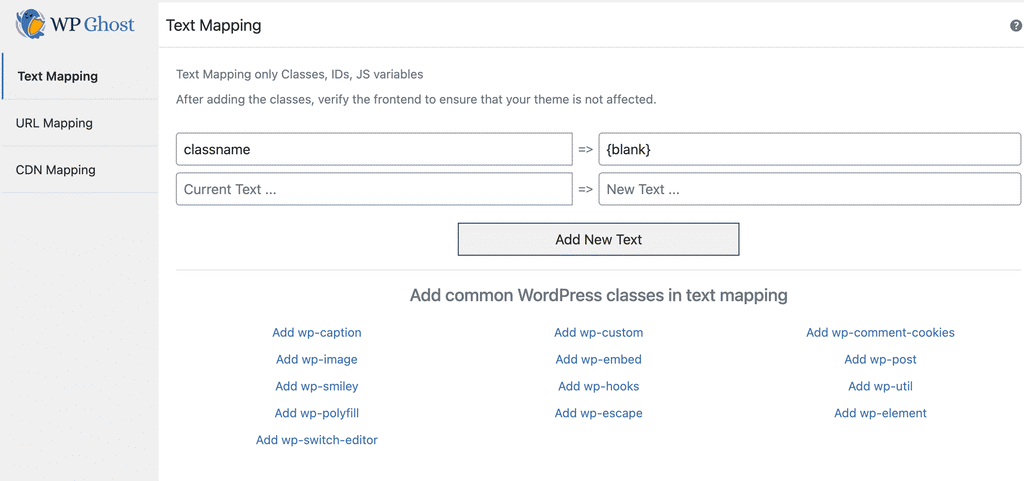
To verify, view your page source in a private browser window and check the <title> and <meta> tags. The WordPress and plugin references should be replaced with your custom text.
For detailed Text Mapping configuration including the {blank} and {rand} patterns, see the Text Mapping tutorial.
Can I Also Change META Text in the Admin Dashboard?
By default, WP Ghost only changes paths and applies mapping on the frontend (what visitors see). If you also need the META replacements to apply inside the admin dashboard, add this line to your wp-config.php file:
define('HMW_ALWAYS_CHANGE_PATHS', true);
This tells WP Ghost to apply path changes and text mapping everywhere, including the admin area. Use this only if you have a specific reason to change META content in the dashboard. For most users, frontend-only mapping is sufficient.
Do I Actually Need Meta Mapping?
Not everyone does. Check your page source first. Open your site in a private browser window, view the source, and search for “WordPress” or your plugin names inside the <title> and <meta> tags. If they’re clean (no CMS references), you don’t need the extension. Standard Text Mapping handles the body content, and the META tags are already fine.
If you do find CMS references in your META tags, the extension is worth installing. It’s free, lightweight, and integrates seamlessly. Just keep in mind that it modifies the text in your page titles and descriptions. Only replace CMS identifiers, not text that’s important for your SEO keyword targeting.
Frequently Asked Questions
What’s the difference between Meta Mapping and standard Text Mapping?
Standard Text Mapping replaces class names and text in the HTML body. Meta Mapping extends those same rules to the content inside META tags in the <head> section, covering titles, descriptions, and other meta elements. Without the extension, Text Mapping rules don’t apply to META tag content.
Will this affect my SEO?
It changes the text content of your META tags, which means your page titles and descriptions in search results will reflect the replacements. If you replace “WordPress” with your brand name, search results show your brand name instead. This is typically a positive change for branding. Be careful not to replace text that’s important for keyword targeting, only replace CMS and plugin identifiers.
Is the Meta Mapping extension free?
Yes. WP Ghost Meta Mapping is a free extension available to all WP Ghost users. Download it from your account and install alongside WP Ghost. Note that because Meta Mapping modifies META tag content across all scenarios and can’t be tested against every plugin combination, technical support is not provided for this extension. Test thoroughly after enabling.
Do I need to configure rules separately for Meta Mapping?
No. Meta Mapping uses the same rules you’ve already set up in WP Ghost > Mapping > Text Mapping. Once the extension is activated, your existing rules automatically apply to META tags too. There’s no separate settings panel.
Does WP Ghost modify WordPress core files?
No. Meta Mapping modifies META tag content in the HTML output at runtime through WordPress filters. No files are modified, moved, or created. Deactivating the extension restores original META tag content instantly.